
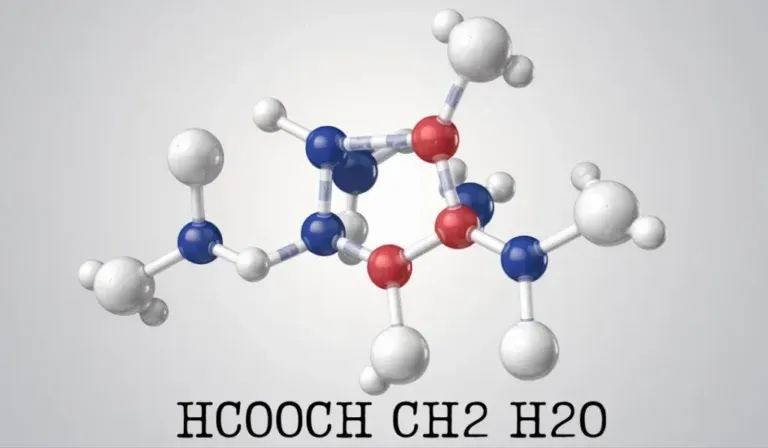
Esters are fascinating compounds that play a crucial role in our everyday lives. They can be found in everything from the sweet scent of fruit to the structure of many products we use daily. But how do these organic molecules interact with water? Enter HCOOCH2 Ch2 H2O, an intriguing ester-watersystem that unveils a world of chemical interactions and applications.
Understanding the chemistry behind esters and their relationship with water opens up new avenues for exploration. Whether you’re a student, a hobbyist, or just someone curious about science, delving into this topic reveals much more than meets the eye.
Join us as we explore the structure of HCOOCH2 Ch2 H2O and unravel its secrets—discovering how esters work alongside water to impact both nature and human innovation. The journey promises surprising insights that will enhance your appreciation for these remarkable compounds!
The Chemical Structure of HCOOCH2 Ch2 H2O
The chemical structure of HCOOCH2 Ch2 H2O reveals a fascinating combination of elements. This compound consists primarily of carbon, hydrogen, and oxygen atoms.
At its core is the ester functional group—essentially derived from carboxylic acids. The formate group (HCOO) contributes to its unique properties, while CH2 units add complexity to its chain.
Water (H2O) plays an important role in this equation. Its polar nature invites interactions with the ester component. This interplay creates interesting dynamics that can be observed in various scenarios.
When examining this molecular structure, one cannot overlook how these connections influence solubility and reactivity. The hydrogen bonds formed between water molecules and the ester can lead to intriguing behaviors in different environments.
Each aspect of HCOOCH2 Ch2 H2O showcases remarkable chemistry at work within everyday contexts.
Understanding the Intermolecular Forces Between Esters and Water
Esters and water interact through a variety of intermolecular forces, creating intriguing dynamics in mixtures. These interactions are primarily driven by hydrogen bonding, dipole-dipole attractions, and van der Waals forces.
Esters, characterized by their carbonyl (C=O) group adjacent to an ether link (-O-), exhibit polar characteristics. This polarity allows them to engage with water molecules effectively. Water itself is highly polar due to its bent molecular shape and strong hydrogen bonds.
When esters mix with water, the positive end of water aligns with the negative regions around the ester’s oxygen atom. This alignment fosters stability within the mixture but can also hinder solubility depending on chain length and branching in the ester structure.
Understanding these forces sheds light on how esters behave in various environments—from flavorings in cooking to solvents in chemical reactions—and helps predict their behavior when mixed with polar solvents like water.
Applications of Esters and Water in Everyday Life
Esters and water play significant roles in our daily lives, often without us realizing it. Esters are commonly used in the food industry as flavoring agents. Their fruity aromas enhance the taste of everything from beverages to baked goods.
In cosmetics and personal care products, esters provide a silky texture and moisturizing properties. They help create that luxurious feel in lotions and creams we apply every day.
Beyond beauty, these compounds also find use in cleaning products. Many household cleaners contain esters for their ability to dissolve grease effectively while being less harsh than traditional solvents.
Moreover, esters serve as solvents themselves in various applications—think paints or adhesives where they help maintain consistency and improve performance.
Water acts as a universal solvent; its role is crucial when mixing substances like esters for optimal efficacy across different environments—be it culinary or industrial settings.
Experiments and Observations on the Interactions Between HCOOCH2 Ch2 H2O
When exploring HCOOCH2 Ch2 H2O, a range of experiments yield fascinating insights. Researchers typically begin by mixing this ester with water in various ratios. The solution’s clarity and homogeneity provide immediate feedback on solubility.
Temperature plays a crucial role as well. Heating the mixture can enhance interactions, showcasing how esters like HCOOCH2 Ch2 respond to thermal changes. Observations reveal that at higher temperatures, evaporation rates increase, impacting both components’ behavior.
Measuring viscosity offers another layer of understanding. Scientists note how the addition of water modifies the thickness of the ester solution. This change affects potential applications in industries ranging from cosmetics to food production.
Conducting these experiments also encourages curiosity about molecular dynamics at play. Visualizing changes under a microscope reveals intricate patterns formed during mixing—an elegant dance between two distinct substances melding into one cohesive entity.
Potential Benefits and Risks of Using Esters and Water Together
Esters and water can create a fascinating dynamic, leading to various benefits in multiple fields. For instance, esters are widely used in the food industry as flavoring agents. Their solubility in water enhances taste profiles without overwhelming them.
Moreover, their applications extend into cosmetics and pharmaceuticals. The combination of esters with water helps formulate products that provide hydration while delivering essential active ingredients effectively.
However, there are risks associated with this mix too. Some esters may hydrolyze when combined with water, potentially altering their intended properties. This could affect product stability or efficacy.
Environmental concerns also arise from the improper disposal of ester-containing solutions mixed with water. Care must be taken to prevent contamination of natural waterways.
Understanding these aspects enables better utilization while minimizing adverse effects on health and the environment.
Conclusion: The Fascinating World of Esters and
The exploration of HCOOCH2 Ch2 H2O reveals a captivating intersection between esters and water. Understanding the chemical structure and intermolecular forces at play deepens our appreciation for these compounds. Their applications in everyday life showcase their versatility, from food flavoring to industrial uses.
Experiments highlight not only the interactions but also the nuances of behavior when esters meet water. While there are numerous benefits to harnessing this combination, it’s essential to acknowledge potential risks as well.
As we delve deeper into chemistry’s intricate dance, we uncover more about how substances interact and affect each other in profound ways. The world of esters invites further inquiry, offering endless opportunities for discovery and innovation that continue to influence various fields today.